

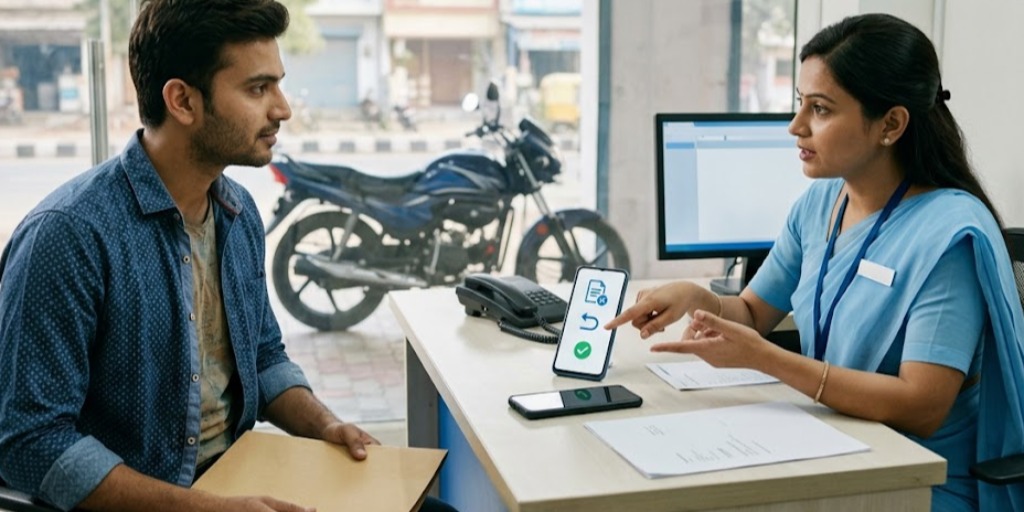
Bike insurance cancellation is allowed mid-term, and the refund is now calculated on the unexpired period. Under IRDAI's master circular of 11 June 2024, a retail policyholder can cancel at any time without giving a reason and receive a proportionate refund for the remaining months, provided no claim has been made in that policy period. The one firm limit is third-party (TP) cover, the legally compulsory part of the policy, which cannot be cancelled except in case of double insurance or total loss of the bike.
Use the table below to estimate a refund before contacting the insurer. It shows the share of the annual premium returned under the current proportionate method, and under the older short-rate scale that many policy wordings used before June 2024.
| Months of cover used | Refund under current proportionate method | Refund under older short-rate scale |
|---|---|---|
| Up to 1 | 91.7% | 80% |
| Up to 2 | 83.3% | 70% |
| Up to 3 | 75.0% | 60% |
| Up to 4 | 66.7% | 50% |
| Up to 5 | 58.3% | 40% |
| Up to 6 | 50.0% | 30% |
| Up to 7 | 41.7% | 20% |
| Up to 8 | 33.3% | 10% |
| More than 8 | Remaining months, proportionately | Nil |
The proportionate figures assume cancellation at the end of each full month and no claim during the policy period. Insurers may apply the calculation by days, so the exact amount can differ slightly.
Reasons You Might Cancel a Bike Insurance Policy
Most requests to cancel a two-wheeler insurance policy fall into a handful of situations, and the reason decides whether cancellation is allowed and how the refund works.
| Reason | Can the policy be cancelled | What to expect |
|---|---|---|
| Bike sold | Usually transferred to the buyer instead | Seller keeps the no-claim bonus for the next bike |
| Two policies on the same bike | Yes, double insurance | Refund on the policy being cancelled |
| Switching to another insurer mid-term | Yes, once the new policy is active | The old policy becomes double insurance |
| Bike stolen or written off | Yes, total loss | Refund for the unexpired period, after the claim is settled |
| Bike scrapped | Yes, with the scrapping certificate | Refund on the unexpired period, subject to the insurer's terms |
| Wrong details on the policy | Not needed | Corrected through an endorsement, a formal change to the policy |
Two points apply across all of them. The bike must stay insured for at least TP cover whenever it is on the road, because riding without it is an offence under Section 196 of the Motor Vehicles Act, 1988. And a claim made during the policy period usually rules out a refund for that period.
Free-Look Period, Cancelling a New Policy
A free-look period is a window after buying a policy during which it can be returned for a refund, after small deductions, without any reason. IRDAI's free-look rules apply to life insurance and health insurance. Motor insurance, including bike insurance, does not come with a free-look period.
That gap matters less than it used to. Since the June 2024 circular, a new bike policy can still be cancelled soon after purchase, with the refund worked out on the unexpired period. The limit is the same as always. The bike must remain insured for TP cover, so cancelling a newly bought policy usually works in these cases.
- A duplicate policy. The dealer issued one at purchase, and the owner bought another online. One of the two can be cancelled as double insurance.
- A mistaken purchase for the wrong vehicle. The insurer can correct the details by endorsement, or cancel and reissue.
A better policy found within days. Buy the new policy first, then cancel the old one as double insurance.
New two-wheelers carry a long-term TP policy bought at the dealership, which cannot be cancelled simply because the owner prefers a different insurer. Only the own-damage (OD) portion, the cover for damage to your own bike, is a free choice at each renewal.
Mid-Term Cancellation, How Refunds Are Calculated (Short-Rate Table)
The bike insurance premium refund rules changed in 2024, which is why older guides show smaller refunds.
The Older Short-Rate Method
A short-rate scale lets the insurer keep more than a straight proportion of the premium for the months used, to cover its costs of issuing the policy. Many two-wheeler wordings used the scale in the table at the top of this guide. An insurer kept 20% of the annual premium for up to one month of cover, 50% for up to four months, and the full premium once more than eight months had passed. Some wordings used a finer scale with weekly steps in the first month.
The Current Proportionate Method
IRDAI's master circular on general insurance (reference IRDAI/NL/MSTCIR/MISC/90/06/2024) now sets the basis for retail policies.
- Policy term up to one year. The insurer refunds a proportion of the premium for the unexpired policy period, provided no claim has been made during the policy period.
- Policy term more than one year. The insurer refunds the premium for the unexpired period for policy years in which cover has not started.
Insurer cancellation. An insurer can cancel only on grounds of established fraud, with at least 7 days' notice.
Worked Example
Take a one-year package policy with an annual premium of ₹2,400 before GST, cancelled after exactly four months with no claim.
- Months unused. 12 minus 4 is 8 months.
- Proportionate refund. ₹2,400 multiplied by 8 and divided by 12 is ₹1,600.
- Refund under the older scale. The insurer would have kept 50%, leaving ₹1,200.
The difference, ₹400 on a modest premium, is the practical gain from the 2024 change.
Multi-Year Policies
For a new bike's long-term policy, premium for future years whose cover has not started is refunded in full where cancellation is allowed. The current year is refunded proportionately. The TP portion is refundable only where the cancellation ground is double insurance or total loss, for example when the bike is stolen or written off.
Cancelling Because You Sold the Bike
Selling a bike does not end the policy. Under Section 157 of the Motor Vehicles Act, the insurance passes to the buyer along with the vehicle, and the buyer should apply to the insurer within 14 days of the transfer to have the policy moved into their name. This protects anyone the buyer might injure in the meantime.
The seller then has two routes.
| Route | How it works | Effect on the seller |
|---|---|---|
| Transfer the policy to the buyer | The insurer endorses the policy in the buyer's name | No refund, but the seller keeps the no-claim bonus |
| Buyer takes a fresh policy | The seller cancels the old policy as double insurance | Refund on the unexpired period, and the seller keeps the no-claim bonus |
No-claim bonus (NCB) is a discount on the OD premium for every claim-free year, rising to 50% after five years. It belongs to the owner, not the bike. When the policy moves to a buyer, insurers usually recover the NCB discount for the rest of the term from the buyer, since the buyer did not earn it.
The seller should ask the insurer for an NCB certificate, a letter confirming the NCB earned, at the time of sale. Use it on the next bike's policy without a long gap, since NCB is generally lost once cover lapses for more than 90 days, and insurers set their own validity for NCB certificates.
Steps for Sellers
- Complete the ownership transfer with the RTO, the regional transport office, using Forms 29 and 30.
- Decide with the buyer whether the policy will be transferred or replaced.
- If transferred, give the buyer the policy copy for the endorsement.
- If replaced, send the cancellation request with proof of the buyer's new policy.
Request the NCB certificate in either case.
Cancelling to Switch Insurers
The simplest way to change insurers is at renewal, when no cancellation is needed at all. The old policy expires and the new insurer issues cover from the next day. NCB carries across on the strength of the previous policy.
A mid-term switch takes two steps in a fixed order.
- Buy the new policy first. The bike must never be without TP cover, so the new policy should start before the old one is cancelled.
Cancel the old policy as double insurance. Send the cancellation request with a copy of the new policy. The refund is calculated on the unexpired period.
Owners of newer bikes have an extra option. Since September 2019, standalone OD cover can be bought from any insurer, provided a valid TP policy exists. So a rider whose long-term TP runs with one insurer can move OD cover elsewhere at renewal without cancelling anything. Comparing two-wheeler insurance plans on Insure24 before renewal shows how OD premium, IDV and add-ons differ between insurers. IDV, the Insured Declared Value, is the most the insurer will pay if the bike is stolen or written off.
Before switching mid-term, check two things. A claim made in the current period usually means no refund on the old policy. And the new policy's NCB should match what was earned, so keep the previous policy copy ready.
Documents Needed to Cancel
Requirements vary slightly by insurer, but most ask for the following.
| Document | Why it is needed |
|---|---|
| Written or online cancellation request | States the policy number and reason |
| Copy of the current policy or certificate of insurance | Identifies the cover being cancelled, and some insurers ask for the original certificate to be surrendered |
| Proof of alternative insurance | Copy of the new policy, for double insurance cases |
| Proof of sale | Forms 29 and 30, or the updated registration certificate |
| Proof of total loss or theft | FIR, the police non-traceable report and the claim settlement letter |
| Scrapping certificate | For bikes scrapped at a registered facility |
| Bank details | A cancelled cheque or account details for the refund |
| KYC documents | Where the insurer needs to verify the policyholder |
A tip that saves time. Send the request from the email address or mobile number registered on the policy, and keep the acknowledgement or reference number.
How Long Refunds Take
IRDAI's June 2024 master circular sets the refund basis but does not set a separate deadline for paying motor cancellation refunds. The timeline depends on the insurer's own process and on how complete the documents are.
The usual bike insurance refund process looks like this.
| Stage | What happens |
|---|---|
| Request received | The insurer acknowledges it and shares a reference number |
| Verification | Documents are checked, and alternative TP cover is confirmed |
| Approval | The refund amount is calculated and the policy is cancelled |
| Payment | The refund goes to the registered bank account or original payment method |
Most delays come from missing documents, especially proof of alternative cover or the sale papers. Sending everything together with the first request is the easiest way to keep the timeline short.
If the refund is delayed or disputed, escalate in order.
- The insurer's grievance officer. IRDAI's Bima Bharosa portal states that insurers should resolve a complaint within 15 days of receiving it.
- IRDAI. Call 155255, email [email protected], or register the complaint on the Bima Bharosa portal.
- Insurance Ombudsman. If the insurer rejects the complaint or does not reply within a month, the Ombudsman can be approached, generally within one year of the insurer's response.
Note: This article has been vetted by Siddarth Khandelwal, an Insurance expert at Insure24.
Frequently Asked Questions
Q. How can bike insurance be cancelled in India?
To cancel bike insurance online, send a request through the insurer's website, app or email, or visit a branch, stating the policy number and reason. Attach the policy copy, proof of the reason such as a new policy or sale papers, and bank details for the refund.
Q. Is there a refund on cancelling bike insurance?
Yes, in most cases. Since June 2024, the refund is a proportion of the premium for the unexpired period, provided no claim has been made during that policy period.
Q. Is there a free-look period for two-wheeler insurance?
No. IRDAI's free-look period applies to life and health insurance. A bike policy can still be cancelled at any time, with a proportionate refund for the unexpired period.
Q. Can third-party bike insurance be cancelled?
Only in case of double insurance or total loss of the bike. TP cover is compulsory by law, so it cannot be cancelled just because the owner no longer wants it.
Q. What happens to bike insurance when the bike is sold?
The policy passes to the buyer under Section 157 of the Motor Vehicles Act, and the buyer should get it transferred within 14 days. If the buyer takes a fresh policy, the seller can cancel the old one as double insurance and claim a refund.
Q. Is the no-claim bonus lost on cancellation?
No. NCB belongs to the owner. Ask the insurer for an NCB certificate and use it on the next policy without a long gap in cover.
Q. Can bike insurance be cancelled after a claim?
Cancellation is possible, but a claim made during the policy period usually rules out a refund for that period.
Q. Can a 5-year bike insurance policy be cancelled?
The long-term TP part can be cancelled only for double insurance or total loss. Where cancellation is allowed, premium for years whose cover has not started is refunded in full.
Q. How is the refund calculated for a mid-term cancellation?
Divide the months or days left by the full term and multiply by the premium. A ₹2,400 one-year premium cancelled after four months returns ₹1,600, if no claim was made.








Licenced by

COMPANY
PRODUCTS
RESOURCES
LEGAL
Cars24 Financial Services Private Limited
(Wholly owned subsidiary of Cars24 Services Private Limited)
Corporate Office - 6th Floor, SAS Tower-C, Ch Baktawar Singh Road, Medicity Sector 38, Shivaji Nagar,
Gurgaon - 122001, Haryana
IRDAI Corporate Agency Registration No: CA0710 | Registration Validity: Perpetual |
CIN: U65990HR2018PTC075713
Disclaimer : The information contained in this website is presented purely for information purposes only provided as service to the internet community at large. It does not constitute insurance advice and we do not guarantee the accuracy, adequacy or the completeness of the information contained here.


Licenced by
COMPANY
PRODUCTS
RESOURCES
LEGAL
Cars24 Financial Services Private Limited
(Wholly owned subsidiary of Cars24 Services Private Limited)
Corporate Office - 6th Floor, SAS Tower-C, Ch Baktawar Singh Road, Medicity Sector 38, Shivaji Nagar,
Gurgaon - 122001, Haryana
IRDAI Corporate Agency Registration No: CA0710
Registration Validity: Perpetual
CIN: U65990HR2018PTC075713
Disclaimer : The information contained in this website is presented purely for information purposes only provided as service to the internet community at large. It does not constitute insurance advice and we do not guarantee the accuracy, adequacy or the completeness of the information contained here.