

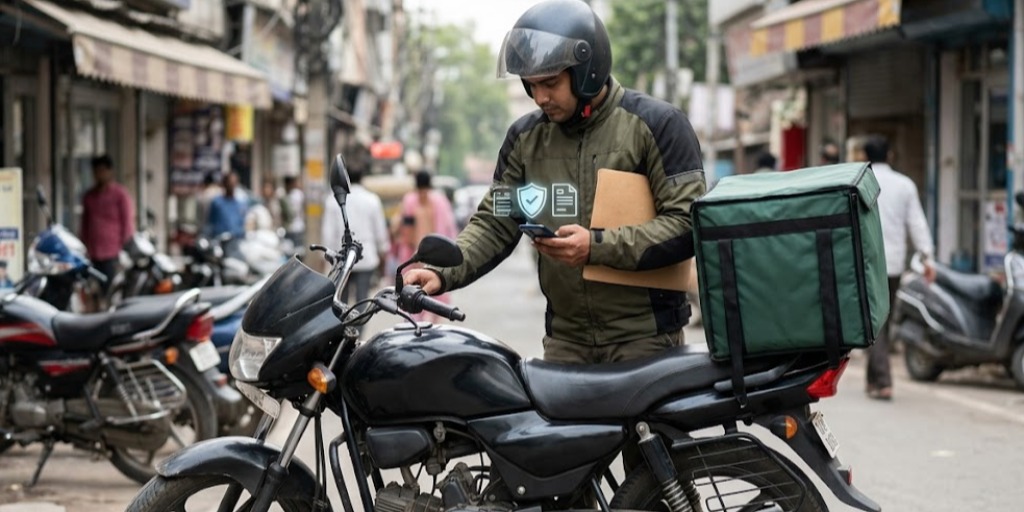
Bike insurance for delivery riders has to cover commercial use, because a standard personal bike insurance policy does not cover a two-wheeler while it is being used to deliver food or parcels, or to carry paying passengers. Private two-wheeler policies exclude use for "hire or reward", which means using the vehicle to earn money by carrying goods or people for someone else. So riders who work with Swiggy, Zomato, Rapido or any similar platform need a policy that names commercial use, usually sold as commercial two-wheeler insurance.
This matters most at claim time. An accident during a delivery shift on a private policy can leave the rider paying for their own repairs, and in serious cases repaying compensation the insurer paid to an injured third party.
- The short answer. Personal policy for personal trips, commercial policy for any bike that earns money on the road.
- What stays the same. Third-party (TP) premium, the part that covers damage or injury caused to other people, is fixed by government notification and is identical at every insurer.
What changes. Own-damage pricing, add-ons and the permitted-use clause, which is exactly what to compare.
Why Regular Bike Insurance Doesn't Cover Delivery Work
Every motor policy has a clause called "Limitations as to Use", which sets out the purposes the vehicle may be used for. The standard private two-wheeler package policy, the combined own-damage and third-party policy most personal riders hold, covers any use except a short list. That list typically includes hire or reward, carriage of goods (other than samples or personal luggage), organised racing, pace making, speed testing and reliability trials.
Two items on that list apply directly to gig work. A food, grocery or parcel delivery is carriage of goods for reward. A bike taxi ride is carriage of a passenger for hire. Either one places the trip outside the policy's permitted use.
The policy's general exceptions then do the rest. The ICICI Lombard two-wheeler package policy wording, which follows the standard format for this clause, says the insurer is not liable for any accidental loss, damage or liability incurred while the vehicle is "being used otherwise than in accordance with the Limitations as to Use".
There is a pricing logic behind the exclusion too. A private policy is priced for a daily commute and weekend errands. A delivery bike can cover several times that distance, much of it in peak traffic, so insurers price commercial use separately.
What Counts as Commercial Use Under the Motor Vehicles Act and Policy Wording
Commercial use is defined by the Motor Vehicles Act, 1988, and by the policy wording that the Insurance Regulatory and Development Authority of India (IRDAI) approves. IRDAI regulates insurers and their products. The Ministry of Road Transport and Highways (MoRTH) defines vehicle classes and notifies third-party premium rates in consultation with IRDAI.
The Motor Vehicles Act Definitions That Matter
| Term (Section of the Motor Vehicles Act, 1988) | Plain meaning | Where gig riders fit |
|---|---|---|
| Goods carriage, Section 2(14) | Any vehicle built for carrying goods, or any vehicle not built for it when it is used to carry goods | A bike delivering food, groceries or parcels |
| Public service vehicle, Section 2(35) | Any vehicle used or adapted to carry passengers for hire or reward | A bike used for paid rides |
| Transport vehicle, Section 2(47) | A public service vehicle, a goods carriage, an educational institution bus or a private service vehicle | Both delivery bikes and bike taxis |
The key phrase is in Section 2(14). A motorcycle does not need to be built for cargo to count as a goods carriage. Using it to carry goods is enough. Under Section 66, a transport vehicle generally needs a permit, although a MoRTH order revised on 6 July 2026 exempts battery-operated and certain alternative-fuel transport vehicles from that requirement for seven years, subject to conditions. A permit exemption does not change how the vehicle is insured.
Bike Taxis and the 2025 Aggregator Guidelines
MoRTH released the Motor Vehicles Aggregator Guidelines, 2025 in July 2025. They allow state governments to permit non-transport (privately registered) motorcycles to be used for passenger journeys through aggregators. Whether bike taxis are allowed is decided state by state, and it has been the subject of court cases and policy reversals, including in Karnataka, so check the state transport department's current position.
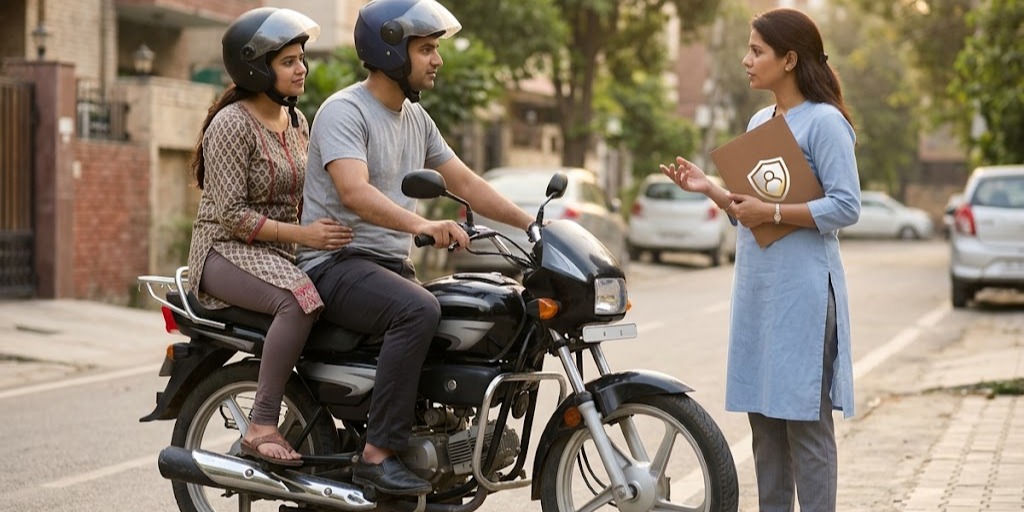
Even then, the bike's own policy must cover passenger carriage for hire, which a private package policy, as written, does not.
Personal or Commercial: A Quick Classification
| How the bike is used | Classification | Covered by a standard private policy |
|---|---|---|
| Commuting to an office or college | Personal use | Yes |
| A sales job where you carry product samples | Personal use (samples are expressly allowed) | Yes, per standard wording |
| Delivering food, groceries or parcels for a platform | Carriage of goods for reward | No |
| Carrying passengers through a ride app | Carriage of passengers for hire | No |
| Delivering for a local shop, paid per order | Carriage of goods for reward | No |
Key Differences Between Personal and Commercial Two-Wheeler Insurance
Commercial two-wheeler insurance, the right form of bike insurance for delivery riders, covers the same core risks as a personal policy, but the permitted use, the premium basis and some cover details differ.
| Feature | Personal (private) two-wheeler policy | Commercial two-wheeler policy |
|---|---|---|
| Permitted use | Social, domestic and pleasure use, including commuting | Use for hire or reward, as named in the policy schedule |
| Delivery or ride-app trips | Excluded under Limitations as to Use | Covered, if the use is declared |
| Third-party premium | Fixed rate for private two-wheelers by engine size | Fixed rate for the commercial class, plus a per-passenger charge for passenger-carrying bikes |
| Own-damage premium | Set by the insurer | Set by the insurer, priced for higher exposure |
| Fare-paying passenger liability | Not covered | Covered on passenger-carrying policies, priced per licensed passenger |
| Registration usually expected | Private (non-transport) | Transport, unless a state or central exemption applies |
What Commercial Bike Insurance Covers
A commercial bike policy comes as liability-only cover or as a package policy that adds own-damage cover. Both include compulsory personal accident cover for the owner-driver unless a qualifying standalone cover is already held.
Third-Party Liability Cover
Third-party liability cover pays for death or injury caused to another person, and damage to their property, in an accident involving the insured bike. Section 146 of the Motor Vehicles Act makes it compulsory for every motor vehicle used in a public place. On a passenger policy, the fare-paying pillion is also covered, hence the per-passenger premium.
A Motor Accident Claims Tribunal decides compensation for death or injury.
Own Damage Cover
Own damage cover pays to repair or replace the rider's own bike after an accident, fire, theft, or natural events such as floods. The maximum payout is the Insured Declared Value (IDV), the bike's current market value as agreed in the policy, roughly the listed price minus age-based depreciation.
Own damage claims usually carry a deductible, the fixed amount the rider pays on each claim before the insurer pays the rest.
PA Cover for the Rider
Compulsory personal accident (CPA) cover pays a fixed sum if the registered owner-driver dies or suffers permanent disability in an accident involving the insured vehicle. The capital sum insured is ₹15 lakh. Under the standard wording, death or permanent total disablement pays 100 per cent, and loss of one limb or one eye pays 50 per cent.
Three details matter for gig riders.
- It covers the owner, not any rider. CPA protects the registered owner who holds a valid driving licence. A rider using a bike registered to a parent, a spouse or a fleet company is not the owner-driver on that policy.
- It does not pay hospital bills. CPA pays only for death and permanent disability. Treatment costs need a health or accident hospitalisation policy.
One standalone CPA can cover several vehicles. Since 1 January 2019, under IRDAI circular IRDAI/NL/CIR/MOTP/200/12/2018, a standalone CPA extends to all vehicles the owner-driver owns, and an owner with an existing personal accident policy of at least ₹15 lakh for death and permanent disability need not buy CPA again.
Premium Difference, Personal vs Commercial Policy
A two-wheeler premium has two parts. The third-party premium is fixed by law and is the same at every insurer. The own-damage premium is priced by each insurer, which has been the case for most general insurance pricing since de-tariffing in 2007.
Third-Party Rates by Law
The rates in force are set by the Motor Vehicles (Third Party Insurance Base Premium and Liability) Rules, 2022, notified by MoRTH as G.S.R. 394(E) on 25 May 2022 and applicable from 1 June 2022. They are identical at every insurer, from HDFC ERGO to SBI General. A revision has been under discussion between IRDAI and the government, but no new rates had been notified at the time of writing, so confirm the current rate on the quote itself.
| Engine capacity | Private two-wheeler, annual TP (₹) | Two-wheeler for hire or reward (class C4), basic TP (₹) | Class C4 with one licensed passenger (₹) |
|---|---|---|---|
| Up to 75 cc | 538 | 861 | 1,441 |
| 75 cc to 150 cc | 714 | 861 | 1,441 |
| 150 cc to 350 cc | 1,366 | 861 | 1,441 |
| Above 350 cc | 2,804 | 2,254 | 2,834 |
The class C4 figures include a per-licensed-passenger charge of ₹580. Electric two-wheelers have their own slabs. A private e-scooter up to 3 kW pays ₹457 a year in TP premium, while an electric two-wheeler in class C4 pays a basic ₹732 plus ₹493 per licensed passenger. All figures are before GST.
For the most common delivery and taxi bikes, in the 100 cc to 125 cc range, the difference in third-party premium between a private policy and a single-passenger commercial one is ₹727 a year. The 2022 rules set no separate third-party row for two-wheelers carrying goods, so a delivery bike's classification depends on the insurer's approved commercial product. Ask which class the quote uses.
Own-Damage Premium
Own-damage premium depends on the bike's IDV, age, city, deductible, any no-claim bonus (a discount for claim-free years) and the insurer's view of the risk. Working bikes cover far more distance, so compare actual quotes for the same bike rather than assuming a figure.
A simple test is to set the yearly premium difference against one rejected claim. If a crash causes a repair bill of, say, ₹15,000, a rider on the wrong policy pays all of it.
What Happens If You Claim on a Personal Policy While Delivering (Claim Rejection Risk)
Misclassification, using a private policy for commercial trips, is one of the clearest grounds on which a rider can lose a motor claim. The outcome depends on which part of the policy the claim falls under.
| Situation during a delivery or ride | Likely outcome on a personal policy |
|---|---|
| Own bike damaged in a crash | The insurer can reject the claim under the Limitations as to Use exception |
| Bike stolen while parked at a restaurant pickup point | The insurer can reject the claim if the bike was in commercial use at the time |
| Rider injures a pedestrian or damages another vehicle | The insurer must pay the victim, then can recover the full amount from the owner |
| Fare-paying pillion passenger injured | The same pay-and-recover risk applies |
Own-Damage Claims
A surveyor, the insurer's appointed assessor, records how and where the accident happened. The first information report (FIR), hospital records, the rider's own statement, a delivery bag on the bike, or order data on the app can all show that the trip was commercial. Once that is established, the insurer can decline the claim. Commercial use not declared on the proposal form can also be treated as non-disclosure of a material fact.
A rejection can be disputed before a consumer commission, but cases take months or years.
Third-Party Claims and "Pay and Recover"
Third-party claims work differently because the law protects the victim first. Courts apply a principle called "pay and recover". The insurer pays the compensation awarded to the injured person, then recovers that amount from the vehicle owner who breached the policy. The Supreme Court set this out in National Insurance Co. Ltd. v. Swaran Singh (2004), and applied it in Amrit Paul Singh v. TATA AIG General Insurance Co. Ltd. (2018), a case involving a vehicle without the required permit.
So the victim is paid, but the bike's owner can then face a recovery claim for the full award, which in a death or serious injury case can run into lakhs of rupees.
Add-ons Delivery Riders Should Consider (RSA, Zero Dep, PA Cover)
Add-ons are optional covers bought with the main policy for an extra premium. Availability on commercial policies varies by insurer, so check each quote's list.
| Add-on | What it does in plain terms | Most useful for |
|---|---|---|
| Roadside assistance (RSA) | Help with a breakdown, flat tyre, dead battery or towing, often 24x7 | Riders working late shifts or long routes where a stranded bike means lost orders |
| Zero depreciation | Pays the full cost of replaced parts without deducting depreciation for the parts' age | Newer bikes, usually within an age limit that varies by insurer |
| Higher personal accident cover | Raises the death and disability payout above the ₹15 lakh CPA | Riders whose family depends on their income |
| Unnamed passenger PA cover | Pays a fixed sum if a pillion passenger dies or is disabled | Bike taxi riders |
| Engine protection | Covers engine damage from water ingress or oil leakage, which standard own-damage cover treats as excluded consequential damage | Riders in flood-prone cities who work through the monsoon |
| Accessories cover | Covers fitted accessories such as a mounted delivery box or phone holder | Riders with costly fittings on the bike |
If the budget allows only one or two add-ons, roadside assistance and zero depreciation usually do the most for a working bike, because every day off the road is a day without orders.
How Aggregator Platforms (Swiggy, Zomato, Rapido) Handle Rider Insurance
Delivery and ride platforms provide group insurance to active partners. It is useful cover, but it is not motor insurance for the bike. Figures below are as each platform or its leadership reported them.
| Platform | What the platform reports providing | Source and date |
|---|---|---|
| Swiggy | Accidental death and disability cover of ₹10 lakh, accidental hospitalisation of ₹2 lakh, accidental outpatient (OPD) cover of ₹10,000, loss of pay for up to three months after an accident, with premium paid entirely by Swiggy | Swiggy's own blog, April 2024 |
| Zomato | Accident insurance of up to ₹10 lakh, medical cover of ₹1 lakh and loss-of-pay cover, with Zomato and Blinkit together spending over ₹100 crore on partner insurance premiums in 2025 | Statements by founder Deepinder Goyal, January 2026 |
| Rapido | Captain terms require captains to hold valid licences, insurance and permits for the vehicle, and say the company may insure captains against accidents at its sole discretion | Rapido's terms and conditions for captains |
None of these published descriptions mentions cover for damage to the rider's own bike or for the rider's liability to third parties. Those remain the rider's responsibility through a motor policy. Reporting by Inc42 in January 2026 also recorded partner complaints about delayed claims, a lack of cashless hospital treatment and minimum-engagement conditions before cover applies.
What the Law Now Requires of Aggregators
- Ride-hailing aggregators. The Motor Vehicles Aggregator Guidelines, 2025 require aggregators to provide each driver with health insurance of at least ₹5 lakh and term insurance of at least ₹10 lakh, and to ensure passenger insurance of at least ₹5 lakh.
All gig and platform work. The Code on Social Security, 2020 came into force with the other labour codes on 21 November 2025. It requires aggregators to contribute 1 to 2 per cent of annual turnover, capped at 5 per cent of the amount paid or payable to gig and platform workers, towards social security schemes, with workers registered through an Aadhaar-linked ID on e-Shram.
These welfare measures sit alongside motor insurance. They do not replace it.
The Cover Gap Check, What Platform Insurance Leaves to the Rider
The more useful question for a working rider is where protection actually ends. The table below maps each common loss to the cover that pays for it.
| Loss after an on-shift accident | Platform group cover | Commercial motor policy | Separate health or accident policy |
|---|---|---|---|
| Repairs to the rider's own bike | Not described as covered | Covered under own damage | Not covered |
| Injury or death caused to someone else | Not described as covered | Covered under third-party liability | Not covered |
| Rider's hospital bill after a crash | Covered up to the platform limit, often reimbursement only | Not covered | Covered up to the sum insured |
| Rider's death or permanent disability | Covered up to the platform limit | ₹15 lakh CPA for the owner-driver | Covered if a personal accident policy is held |
| Illness unrelated to an accident | Limited or not covered | Not covered | Covered by a health policy |
| Income lost while recovering | Loss of pay, subject to platform terms | Not covered | Only if a policy offers a daily cash or income benefit |
Illness is the easiest gap to miss. Platform cover is built around accidents, so a rider with no separate policy pays personally for dengue treatment, a surgery or a family member's hospital stay. A basic individual or family policy fills that gap. When comparing health insurance plans for individuals and families, on Insure24 or elsewhere, sum insured, waiting periods and network hospitals matter more than premium alone.
Situations That Change the Answer
- Renting a fleet EV. The fleet owner insures the vehicle and the rider is not the owner-driver for CPA purposes. Ask for the policy schedule, check that it names commercial use, and consider personal accident cover in the rider's own name.
- Riding a family member's bike. The policy must still cover commercial use, and CPA protects the registered owner, not the rider.
- Low-speed e-scooters. Electric two-wheelers with a motor of up to 250 W and a top speed of up to 25 km/h are exempt from registration, and so fall outside compulsory motor insurance. Scooters modified to go faster lose the exemption.
- Occasional or weekend riders. The exclusion applies to the trip, not to how often the rider works. A single delivery on a personal policy is still outside cover.
Leaving delivery work. A bike that goes back to personal use only can return to a private policy at renewal. Since third-party premium is fixed, two-wheeler insurance plans for personal use differ mainly on own-damage premium, IDV and add-ons.
How to Buy Commercial Two-Wheeler Insurance Online
The one step that matters most is declaring the actual use.
- Check the registration certificate. Note whether the bike is registered as a private (non-transport) or transport vehicle. If the state requires transport registration for delivery or taxi use, the regional transport office (RTO) process to change the class comes first, and the exact form and fee vary by state.
- Decide the use to declare. Delivery of goods and carriage of passengers are priced differently. A bike used for both should have both uses accepted in writing.
- Keep documents ready. The registration certificate, driving licence, previous policy, know-your-customer (KYC) documents and, where applicable, the permit and fitness certificate.
- Request quotes that name commercial use. Ask each insurer which vehicle class the quote uses and whether personal trips are also covered under the same policy.
- Compare what actually differs. Third-party premium is identical everywhere. Compare own-damage premium, IDV, deductible, add-ons and the insurer's claim process.
Read the policy schedule before paying. Check the Limitations as to Use section, the named owner and the add-ons, and keep a digital copy on the phone.
Claim Process on a Commercial Two-Wheeler Policy
| Step | What to do |
|---|---|
| 1 | Get medical help and inform the insurer's helpline promptly |
| 2 | File an FIR for theft, injury to a third party or major damage |
| 3 | Photograph the bike, the scene and any other vehicle involved |
| 4 | Use a network garage for cashless repair, or any garage for reimbursement |
| 5 | Submit the claim form, licence, registration certificate, policy copy and FIR |
| 6 | Allow the surveyor to inspect the bike before repair begins |
| 7 | Pay the deductible, and the insurer settles the rest |
Note: This article has been vetted by Siddarth Khandelwal, an Insurance expert at Insure24.
Frequently Asked Questions
Q. Does personal bike insurance cover delivery work?
No. A standard private two-wheeler policy excludes use for hire or reward and for carriage of goods other than samples or personal luggage. A crash during a delivery trip falls outside that permitted use, so the insurer can reject an own-damage claim.
Q. Is Swiggy or Zomato rider insurance mandatory?
Motor insurance for the bike is mandatory by law under Section 146 of the Motor Vehicles Act, whatever the platform provides. Swiggy and Zomato provide group accident and medical cover at their own cost, but it does not insure the bike or third-party liability.
Q. How much does commercial bike insurance cost in India?
The third-party part is fixed by law. A 100 cc to 150 cc bike used for carrying passengers pays a basic ₹861 plus ₹580 per licensed passenger, which is ₹1,441 before GST for one pillion seat. Own-damage premium varies by insurer, IDV, city and add-ons, so compare actual quotes.
Q. What happens if a claim is filed on a personal policy while delivering?
An own-damage claim can be rejected under the Limitations as to Use exception. If a third party is injured, the insurer pays the victim and can then recover the full amount from the owner under the pay-and-recover principle upheld by the Supreme Court.
Q. Does platform insurance cover damage to the rider's bike?
The published descriptions of Swiggy's and Zomato's partner insurance do not mention repairs to the rider's own bike. That needs own-damage cover under a motor policy.
Q. Is the ₹15 lakh CPA cover enough for a delivery rider?
CPA pays only on death or permanent disability of the registered owner-driver, not hospital bills, and not for a rider who does not own the bike. A higher personal accident cover and a health policy fill those gaps.
Q. Can a privately registered bike be used for Rapido or other bike taxi rides?
Only where the state allows it, under the Motor Vehicles Aggregator Guidelines, 2025, and the bike's insurance must still cover carrying passengers for hire.
Q. Do part-time or weekend delivery riders need commercial cover?
Yes. The exclusion applies to each trip made for hire or reward, however few hours are worked. Ask the insurer to confirm that the commercial policy also covers personal trips.
Q. Does zero depreciation cover apply to commercial bikes?
Some insurers offer zero depreciation on bikes used for delivery work, but availability and the age limit vary by insurer. Check the add-on list on each quote.
Q. Are electric delivery scooters treated differently?
Registered electric two-wheelers have their own third-party slabs, from ₹457 a year for a private scooter up to 3 kW, and battery-operated transport vehicles are exempt from the permit requirement. They still need insurance that covers commercial use. Low-speed scooters with a motor of up to 250 W and a top speed of up to 25 km/h are exempt from registration and compulsory insurance.
Q. Does commercial bike insurance cover the goods being delivered?
No. A motor policy covers the vehicle and third-party liability, not the customer's order. A mounted delivery box can be covered under accessories cover.
Q. What is the penalty for riding without valid insurance?
Under Section 196 of the Motor Vehicles Act, a first offence carries a fine of ₹2,000, imprisonment of up to three months, or both. A subsequent offence carries a fine of ₹4,000, imprisonment of up to three months, or both.







Licenced by

COMPANY
PRODUCTS
RESOURCES
LEGAL
Cars24 Financial Services Private Limited
(Wholly owned subsidiary of Cars24 Services Private Limited)
Corporate Office - 6th Floor, SAS Tower-C, Ch Baktawar Singh Road, Medicity Sector 38, Shivaji Nagar,
Gurgaon - 122001, Haryana
IRDAI Corporate Agency Registration No: CA0710 | Registration Validity: Perpetual |
CIN: U65990HR2018PTC075713
Disclaimer : The information contained in this website is presented purely for information purposes only provided as service to the internet community at large. It does not constitute insurance advice and we do not guarantee the accuracy, adequacy or the completeness of the information contained here.


Licenced by
COMPANY
PRODUCTS
RESOURCES
LEGAL
Cars24 Financial Services Private Limited
(Wholly owned subsidiary of Cars24 Services Private Limited)
Corporate Office - 6th Floor, SAS Tower-C, Ch Baktawar Singh Road, Medicity Sector 38, Shivaji Nagar,
Gurgaon - 122001, Haryana
IRDAI Corporate Agency Registration No: CA0710
Registration Validity: Perpetual
CIN: U65990HR2018PTC075713
Disclaimer : The information contained in this website is presented purely for information purposes only provided as service to the internet community at large. It does not constitute insurance advice and we do not guarantee the accuracy, adequacy or the completeness of the information contained here.