


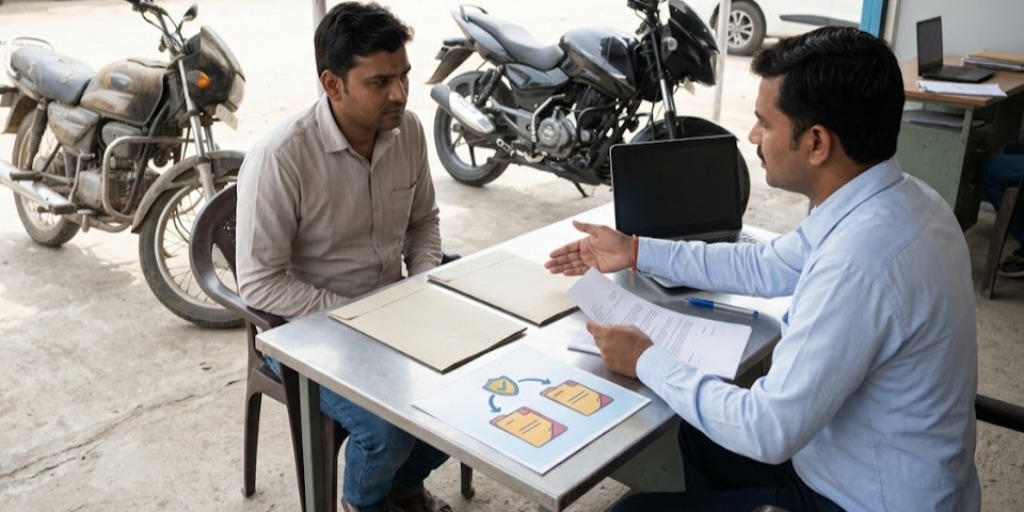
Yes, owners can transfer NCB to a new bike. No-claim bonus (NCB) is a discount on the own-damage premium for claim-free years, and it belongs to the policyholder, not the vehicle. When an owner sells or replaces a bike, the NCB earned can be applied to the policy on the next bike, provided that bike is of the same class, the owner is the same person, and the transfer happens within the insurer's validity period.
The rule has deep roots. The India Motor Tariff, whose NCB regulation insurers still largely follow, states that the NCB entitlement applies to a substituted vehicle provided it is of the same class as the vehicle on which the NCB was earned. This guide covers only the transfer mechanics when changing bikes. The steps are numbered so they can be followed in order.
Can NCB Be Transferred to a Different Bike You Buy
NCB moves with the owner, so it can be carried to a different bike. Five conditions decide whether it applies.
| Condition | What it means in practice |
|---|---|
| Same owner | The new bike's policy must be in the name of the person who earned the NCB |
| Same vehicle class | A two-wheeler's NCB goes to another two-wheeler, not to a car or a commercial vehicle |
| No claim in the last policy year | A claim during the expiring policy resets NCB to nil at the next renewal |
| Within the validity period | The NCB must be used before it lapses, as explained below |
| Proof from the previous insurer | Usually an NCB certificate or the previous policy showing the NCB earned |
The brand, model and engine size of the new bike do not matter, as long as it is in the same class. An owner moving from a 110 cc scooter to a 200 cc motorcycle can carry the same NCB percentage across.
NCB Slabs and What They Are Worth
| Claim-free years | NCB on the OD premium |
|---|---|
| 1 | 20% |
| 2 | 25% |
| 3 | 35% |
| 4 | 45% |
| 5 or more | 50% |
The discount applies only to the own-damage (OD) premium, the part that covers the bike itself. The third-party premium is fixed by law and never gets NCB. On a new bike with a higher value, the same percentage is worth more in rupees. A 35% NCB applied to a new bike with an OD premium of ₹2,400, for instance, saves ₹840 in the first year.
What NCB Cannot Do
- It cannot go to the buyer of the old bike. When a bike is sold, the NCB stays with the seller. Insurers usually recover the NCB discount for the rest of the term from a buyer who takes over the old policy.
- It cannot move between family members during the owner's lifetime. The tariff's one exception is death. When an individual owner dies and the vehicle passes to the spouse, children or parents, the NCB passes to them.
It cannot move from a car to a bike. The class must match.
This also means NCB adds nothing to a used bike's resale value. A listing that advertises a bike as being sold with a high NCB is describing a discount the buyer cannot use, because it stays with the seller.
How NCB Transfer Works When You Upgrade or Change Bikes
The steps to carry forward NCB on a two-wheeler are the same whether the old bike is sold, scrapped or kept off the road.
- Keep the old policy claim-free until the switch. A claim before the policy ends resets NCB to nil.
- Decide what happens to the old policy. If the old bike is sold, either the policy is transferred to the buyer, or the buyer takes a fresh policy and the old one is cancelled as double insurance. In both cases the seller keeps the NCB.
- Request an NCB certificate from the old insurer. Ask for it at the time of sale or cancellation, as described in the next section.
- Buy the new bike's policy in the same name. Give the new insurer the NCB certificate, or the previous policy showing the NCB, when taking the quote.
- Check the NCB percentage on the new policy schedule. The schedule should show the NCB applied to the OD premium before paying.
Keep the documents. The NCB certificate and old policy may be needed if the new insurer asks for verification later.
A Worked Example
An owner has ridden a scooter for four claim-free years and holds a 45% NCB. She sells it in January 2026, takes an NCB certificate from her insurer, and buys a Pulsar NS200 the following month. The OD benchmark for a new NS200 is about ₹2,356 at the former tariff rate in a Zone A city. Applying her 45% NCB brings that to about ₹1,296, a saving of roughly ₹1,060 in the first year. If the new bike's first policy year is also claim-free, the NCB rises to 50% at the next renewal, because the claim-free record continues from the old bike.
Timing Matters
Under the tariff, NCB is normally lost if a policy is not renewed within 90 days of its expiry. There is a specific relief for owners who sell a bike and do not replace it immediately. The tariff allows NCB on a fresh policy within three years of the previous policy's expiry where the vehicle was sold or laid up. Insurers now state their own validity for NCB certificates. ICICI Lombard, for example, says its NCB retention certificate is valid for up to two years from the date of issue, while Zurich Kotak notes that most insurers consider the certificate valid for up to three years. Check the validity printed on the certificate itself.
Getting an NCB Certificate from Your Previous Insurer
An NCB certificate, also called an NCB retention certificate or NCB reserving letter, is a letter from the insurer confirming the NCB percentage the owner has earned. It is the cleanest proof for the new insurer.
- Contact the insurer before or at the time of sale. Use the insurer's app, website, email or branch.
- Submit the request with supporting documents. These usually include a request letter, the original policy, and proof that the bike has been sold or delivered.
- Cancel or transfer the old policy. Insurers usually issue the certificate once the old policy is cancelled or transferred to the buyer.
- Receive the certificate. It states the owner's name, the old vehicle's registration number, the NCB percentage and usually its validity.
Check the details. The name must match the owner's name on the new bike's policy, and the percentage must match the claim-free record.
Owners who scrap a bike or stop riding it can ask the insurer for the same letter. The tariff's three-year relief covered vehicles that were sold or laid up, meaning taken off the road.
Documents Required for NCB Transfer
Requirements vary slightly between insurers. The table combines what insurers such as ICICI Lombard and Zurich Kotak list.
| Document | Why it is needed |
|---|---|
| Request letter to the old insurer | Asks for cancellation or transfer and the NCB certificate |
| Original policy or certificate of insurance of the old bike | Identifies the policy and the NCB earned |
| Proof of sale or delivery | Forms 29 and 30, the sale agreement or a delivery note |
| Registration certificate of the old bike with the new owner's name, where available | Confirms the transfer of ownership |
| NCB certificate from the old insurer | Proof of NCB for the new insurer |
| Registration details or invoice of the new bike | Links the NCB to the new vehicle |
| KYC documents | Verifies that the owner is the same person |
What If You Switch Insurers at the Same Time
Changing bikes and insurers together is common, and NCB carries across both changes. Under the tariff, the new insurer may allow the same NCB on evidence of entitlement, either a renewal notice or a letter confirming the NCB from the previous insurer.
- Get the NCB certificate from the old insurer first.
- Share it with the new insurer when taking the quote, along with the old policy number.
Confirm the NCB on the new schedule before paying.
Where written evidence is not available, the tariff allowed the insured to give a declaration confirming the NCB claimed. That declaration carries a condition. If the NCB turns out to be incorrect, the own-damage cover under the policy stands forfeited. It is safer to wait for the certificate than to rely on a declaration. An incorrect NCB percentage, even one claimed by mistake, can surface when a claim is made, so the figure on the new policy should match the certificate exactly.
Comparing two-wheeler insurance plans for the new bike, on Insure24 or directly with insurers, is simplest with the NCB percentage already confirmed, since every quote then applies the same discount.
Common Reasons NCB Transfer Requests Get Delayed
| Reason | How to avoid it |
|---|---|
| The old policy had a claim in its last year | Check the claim history before assuming NCB is available |
| The certificate was requested after the policy lapsed | Request it at the time of sale or cancellation |
| The validity period expired | Use the certificate before the date printed on it |
| Name mismatch between the old and new policy | Buy the new policy in exactly the same name as the old one |
| The new vehicle is in a different class | Remember that two-wheeler NCB applies only to another two-wheeler |
| The old policy was neither cancelled nor transferred | Complete the transfer to the buyer, or cancel it with proof of the buyer's new policy |
| Missing sale documents | Keep Forms 29 and 30 or the sale agreement ready |
| The new policy was bought from a dealer without the NCB details | Share the NCB certificate with the dealer's insurer before the policy is issued |
The last point catches many buyers. When a new bike is bought, the dealer often arranges the policy on the spot. Unless the NCB certificate is shared before that policy is issued, the new policy may start with no NCB, and correcting it later takes more effort.
Note: This article has been vetted by Siddarth Khandelwal, an Insurance expert at Insure24.
Frequently Asked Questions
Q. Can NCB be transferred from an old bike to a new bike?
Yes. NCB belongs to the policyholder, so it can be applied to the policy on a new two-wheeler in the same name, within the insurer's validity period and provided no claim was made in the last policy year.
Q. How is an NCB certificate obtained when selling a bike?
Request it from the old insurer at the time of sale, with a request letter, the original policy and proof of sale or delivery. Insurers usually issue it once the old policy is cancelled or transferred to the buyer.
Q. Does NCB transfer to a different bike brand?
Yes. The brand, model and engine size do not matter, only that the new vehicle is in the same class, another two-wheeler.
Q. Can bike NCB be transferred to a car?
No. The tariff allows NCB only on a substituted vehicle of the same class, so a two-wheeler's NCB cannot be used on a car.
Q. How long is an NCB certificate valid?
It depends on the insurer. ICICI Lombard states two years from issue, while many insurers allow up to three years. The former tariff allowed NCB on a fresh policy within three years of the previous policy's expiry where the vehicle was sold.
Q. Does the buyer of the old bike get the seller's NCB?
No. NCB stays with the seller. A buyer who takes over the old policy usually has the NCB discount recovered for the rest of the term.
Q. Can NCB be transferred to a family member?
Only on the owner's death, when the vehicle passes to the spouse, children or parents. Otherwise it stays with the person who earned it.
Q. What if the new bike is bought before the old one is sold?
NCB is earned by the owner on a claim-free policy, so ask both insurers how they will apply it before buying the new policy. Selling the old bike first, and taking the certificate at that point, keeps the process simplest.
Q. Is NCB applied to the third-party premium?
No. NCB reduces only the OD premium. The third-party premium is fixed by law.
Q. Can NCB be carried forward if there is a long gap between bikes?
Often, yes, if the NCB certificate is still valid. The former tariff allowed NCB on a fresh policy within three years of the previous policy's expiry where the vehicle was sold, and insurers now print their own validity on the certificate, so check that date.





Licenced by

COMPANY
PRODUCTS
RESOURCES
LEGAL
Cars24 Financial Services Private Limited
(Wholly owned subsidiary of Cars24 Services Private Limited)
Corporate Office - 6th Floor, SAS Tower-C, Ch Baktawar Singh Road, Medicity Sector 38, Shivaji Nagar,
Gurgaon - 122001, Haryana
IRDAI Corporate Agency Registration No: CA0710 | Registration Validity: Perpetual |
CIN: U65990HR2018PTC075713
Disclaimer : The information contained in this website is presented purely for information purposes only provided as service to the internet community at large. It does not constitute insurance advice and we do not guarantee the accuracy, adequacy or the completeness of the information contained here.


Licenced by
COMPANY
PRODUCTS
RESOURCES
LEGAL
Cars24 Financial Services Private Limited
(Wholly owned subsidiary of Cars24 Services Private Limited)
Corporate Office - 6th Floor, SAS Tower-C, Ch Baktawar Singh Road, Medicity Sector 38, Shivaji Nagar,
Gurgaon - 122001, Haryana
IRDAI Corporate Agency Registration No: CA0710
Registration Validity: Perpetual
CIN: U65990HR2018PTC075713
Disclaimer : The information contained in this website is presented purely for information purposes only provided as service to the internet community at large. It does not constitute insurance advice and we do not guarantee the accuracy, adequacy or the completeness of the information contained here.