



Most car owners look at their car insurance premium for ten seconds, compare them with last year's amount, and pay. They never ask the most important question. How was this number actually calculated? Why is it higher this year? And what can I do to bring it down without losing cover? The truth is that your car insurance premium is not random. Insurers use a clear formula built around seven main factors. Once you understand each one, you can use a car insurance premium calculator like a pro, predict your renewal cost, and find easy ways to save Rs 2,000 to Rs 8,000 every year without compromising on protection.
The good news is that the major car insurance premium factors are public knowledge. IRDAI publishes the third-party rates, and insurers also disclose the depreciation tables. NCB slabs are also uniform across the industry. The only thing that has been missing for most car owners is a single resource that puts all of it together in plain language. For those wondering how is car insurance premium calculated in India, this guide breaks down every factor with simple examples and ten practical tips to reduce car insurance premiums at your next renewal.
How is a Car Insurance Premium Calculated?
Every comprehensive car insurance premium in India is built from two main parts. The own damage premium and the third-party premium. Add-ons and GST sit on top of these two components to form the final quote. The simple formula that arrives at the total premium includes the following calculations:
Own Damage Premium = IDV x Premium Rate x Factors (Age, Engine Capacity, Location, NCB, Deductible)
Total Premium = OD Premium + TP Premium + Add-ons + 18% GST
The own damage premium is the part insurers compete on. They set it freely based on your car's profile and their internal risk math. The third-party premium is fixed every year by IRDAI and depends only on your engine size. Add-ons are extras, depending on what you choose. GST is the same 18% across all insurers. This is the core formula that every buyer wondering how is car insurance premium calculated in 2026 must know. The factors below explain why two cars of the same model can have very different premiums on the same day.
Factor 1: IDV (Insured Declared Value)
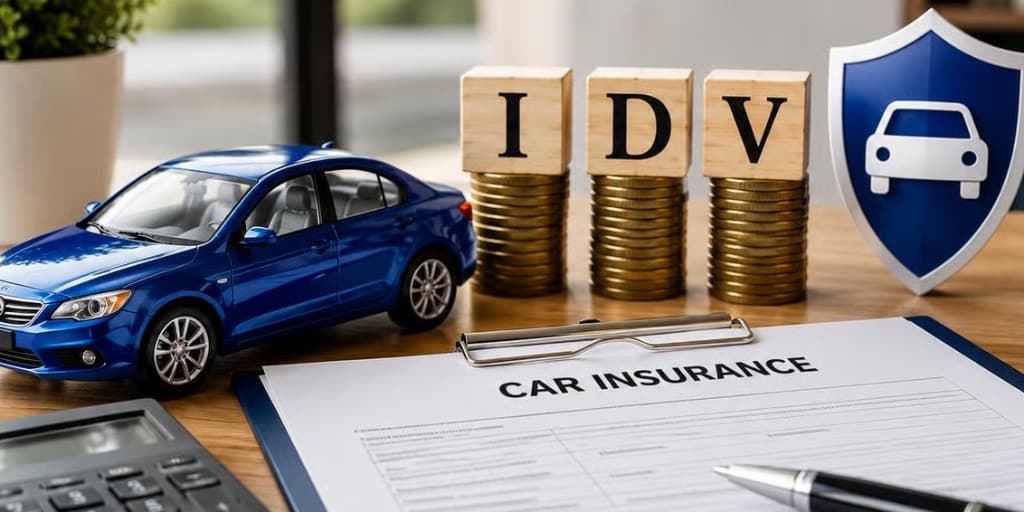
The car insurance IDV is the single biggest factor in your premium. It is also the amount you receive if your car is stolen or fully destroyed.
How is the IDV Set?
The IDV of your vehicle is calculated as the car's ex-showroom price minus depreciation based on age. The insurer also factors in the make, model, variant, and location of registration. You can adjust the suggested IDV slightly during purchase, usually within a 5 to 10% range. A higher IDV means a higher car insurance premium, but also a bigger payout in case of total loss. A lower IDV, on the other hand, reduces your premium but also shrinks your claim amount.
IDV Depreciation Table by Car Age
Here is the standard IRDAI depreciation schedule used by all insurers in India.
| Car Age | Depreciation Rate | IDV as a percentage of Ex-Showroom Price |
|---|---|---|
| Less than 6 months | 5% | 95% |
| 6 months to 1 year | 15% | 85% |
| 1 to 2 years | 20% | 80% |
| 2 to 3 years | 30% | 70% |
| 3 to 4 years | 40% | 60% |
| 4 to 5 years | 50% | 50% |
| More than 5 years | Mutually agreed | Varies by condition |
Use this table to estimate your IDV before getting quotes. If an insurer's suggested IDV is wildly different from this benchmark, ask for an explanation.
Higher vs Lower IDV Impact
This is the Goldilocks zone of car insurance. Set IDV too low and your claim payout falls short by Rs 30,000 to Rs 1 lakh during a total loss. Set it too high, and the insurer may reject the claim or pay only the fair market value, while you have already paid an extra premium for years.
The right approach, therefore, is to stay within 5 to 10% of the standard suggested IDV. This balance gives you fair claim protection without overpaying on your car insurance premium.
Factor 2: Engine Capacity (CC)
The engine size of your car directly impacts the third-party portion of your premium. IRDAI rates are slab-based. A 1000cc car falls in one slab, while a 1500cc car falls in a higher one. Smaller engines, on the other hand, mean lower premiums. A Maruti Alto with an 800cc engine pays much less third-party premium than a Toyota Fortuner with a 2700cc engine. Engine capacity also affects the own damage portion indirectly because larger engines often power costlier cars. If you are comparing two cars before buying, the engine size is a useful proxy for your long-term insurance cost.
Factor 3: Car Age
If you are wondering, does car age affect insurance premium? The answer is absolutely yes. As your car gets older, the IDV drops, which reduces your premium. However, repair costs and breakdown risk increase, which can push some specific components of the premium upward.
For most cars between 1 and 5 years old, the premium drops every year because the IDV drop outweighs other factors. After 5 to 7 years, the drop slows down. By the time your car is 10 years old, the car insurance premium by car age curve flattens, and many add-ons stop being available. If you have noticed your premium falling each year while the policy structure stays the same, you can thank natural depreciation for it.
Factor 4: NCB (No Claim Bonus)
The car insurance NCB is one of the most powerful discounts available on your policy. It rewards you with a percentage off your own damage premium for every claim-free year.
NCB Slab Table 20% to 50%
| Claim-Free Years | NCB Discount on Own Damage Premium |
|---|---|
| After 1 claim-free year | 20% |
| After 2 consecutive claim-free years | 25% |
| After 3 consecutive claim-free years | 35% |
| After 4 consecutive claim-free years | 45% |
| After 5 consecutive claim-free years | 50% |
The discount stops at 50%, but staying claim-free beyond five years still keeps you at the top slab. Make one claim, and the NCB drops back to zero on renewal.
How to Transfer NCB
NCB belongs to you, not your car. If you sell your old car and buy a new one, your existing NCB can be transferred to the new car's policy. Ask your previous insurer for an NCB certificate. Submit it to the new insurer at the time of policy purchase. The discount applies to the first renewal of the new car.
You can also transfer NCB when switching insurers. The new insurer simply asks for the certificate or verifies it through the IIB database.
NCB Protect Add-on
A single claim wipes out your hard-earned NCB. The NCB protect add-on prevents this. Even after one or two small claims, your NCB stays intact, with only a one slab fluctuation depending upon the insurer. At Rs 200 to Rs 700 a year, this is excellent value for drivers at the 35% slab and above. NCB, on its own, is the biggest legal way to reduce car insurance premiums year after year.
Factor 5: Location (Metro vs Tier-2)
Where your car is registered changes your premium. Insurers split India into two main zones for own damage premium calculation:
Zone A: includes metro cities like Mumbai, Delhi NCR, Bengaluru, Chennai, Kolkata, Hyderabad, Ahmedabad, and Pune. Premiums here are higher because of denser traffic, higher accident frequency, and bigger theft risk.
Zone B: covers the rest of India, mainly smaller cities and towns. Premiums in Zone B can be 5 to 10% lower for the same car.
You cannot change your zone without changing your car's registered city. But if you are planning to move or buy a second car, location is one of the silent factors that affect your car insurance cost in India.
Factor 6: Add-ons Selected
Every add-on you choose adds to the base premium. Zero depreciation, engine protection, RSA, NCB protection, return to invoice, and consumables cover are the most popular ones.
A car with three to four add-ons typically pays Rs 4,000 to Rs 7,000 more than a base comprehensive policy. The extra cost is usually worth it because add-ons deliver high value during a claim. The key is to take only the add-ons that match your real risks. Each unnecessary add-on inflates your premium without adding meaningful protection. A smart selection reduces the overall car insurance price while still keeping the policy strong.
Factor 7: Voluntary Deductible
This is one of the most underused tools to control your premium. For those wondering what is voluntary deductible in car insurance is, it is an amount you voluntarily agree to pay out of your pocket during a claim, on top of the compulsory deductible.
In return, the insurer reduces your premium. Standard voluntary deductible options are Rs 2,500, Rs 5,000, Rs 7,500, Rs 10,000, and Rs 15,000. The premium discount ranges roughly from 20% to 35% (subject to mandatory cappings), depending on the deduction amount chosen. A Rs 5,000 voluntary deductible with a 25% discount can thus save you Rs 2,500 (capped limit) in annual premium for a mid-segment car.
Take this option only if you can comfortably pay the deductible during a claim. For careful drivers who rarely make small claims, a moderate voluntary deductible is a smart way to reduce car insurance premiums without losing coverage.
Third Party Premium: IRDAI Fixed Rates Table
The third-party portion of your car insurance premium is set by IRDAI every year. All insurers charge the exact same rate. Here is the latest TP rate reference table for private cars.
| Engine Capacity | Annual TP Premium |
|---|---|
| Up to 1000cc | Rs 2,094 |
| 1001cc to 1500cc | Rs 3,416 |
| Above 1500cc | Rs 7,897 |
These rates are revised periodically. They cover the legally mandatory third-party portion only. Add the own damage premium and GST on top to get your full car insurance price. TP rates have stayed relatively stable in recent years. They are the floor of your premium and cannot be negotiated.
10 Tips to Lower Your Car Insurance Premium
Here are ten practical ways to reduce car insurance premium at your next renewal. Most of these can be applied without any agent help.
1. Drive claim-free: Every claim-free year builds your NCB. A 50% NCB slab can cut your own damage premium in half.
2. Skip small claims: If a repair costs less than Rs 10,000, pay out of pocket. The NCB lost on a small claim, which usually costs more over five years than the claim amount.
3. Set the right IDV: Use the standard suggested IDV. Do not push it too high to feel "safer." It just raises the premium without a proportional benefit.
4. Choose a voluntary deductible: If you are a careful driver, take Rs 5,000 to Rs 10,000 in a voluntary deductible. The premium drop is meaningful.
5. Compare three to five insurers every year: Loyalty does not always pay. A 30 to 40% difference between insurers for the same car is common.
6. Take only the add-ons you need: Drop unused add-ons at renewal. Keep zero dep and engine protection. Skip the daily allowance or key replacement if they do not match your life.
7. Join a recognised car club: Some insurers offer 5% off (maximum of Rs. 200) if your car is registered with an Automobile Association of India member club.
8. Buy online: Online policies often come with a 5 to 15% discount compared to offline channels.
9. Renew on time: Lapsed policies lose NCB and may need a fresh inspection. Always renew 7 to 15 days before expiry.
10. Bundle Your Policies: Several insurance providers offer loyalty discounts if you bundle your motor, health and other insurance policies from the same insure.
Apply even three of these tips, and you can typically save Rs 2,000 to Rs 5,000 on a mid-segment car's renewal.
Common Mistakes That Inflate Your Premium
Even careful buyers fall into a few traps that quietly raise their car insurance premiums without adding any extra protection. Avoiding these mistakes is just as valuable as chasing discounts.
- Auto-renewing without comparing: Most insurers send auto-renewal reminders with last year's premium plus a small inflation bump. Many car owners click pay without checking other quotes. This single habit costs Indian car owners thousands of rupees every year. A two-minute comparison can flip the math entirely.
- Adding every available add-on: Some buyers feel safer with more add-ons. The reality is that unused add-ons add to your premium without adding to your protection. A new car may need five add-ons. A 7-year-old hatchback may need just one.
- Claiming for minor damage: A Rs 6,000 claim feels like a win in the moment. But it resets a 50% NCB to zero. The lost discount over the next five years is usually higher than the claim itself.
- Choosing the wrong voluntary deductible: Some buyers pick the highest deductible to grab a big premium discount, then struggle to pay it during a claim. Match your deductible to your real cash comfort level.
- Skipping anti-theft device discounts: Many owners install an AIS 140 GPS device but never share the certificate with their insurer. A simple form can unlock a 2.5% discount on the own damage portion.
- Insuring an old car like a new one: Cars older than 7 years rarely benefit from zero depreciation or return to invoice. Yet many owners continue paying for these add-ons out of habit. Review your add-on list every renewal.
Ignoring the NCB transfer at car upgrade: When you sell your old car and buy a new one, your NCB does not move automatically. You must request an NCB certificate and submit it to the new insurer. Missing this step can cost you 35 to 50% on year one of the new policy.
Car Insurance Premium in India: Final Thoughts
Your car insurance premium is the sum of seven moving parts. IDV, engine capacity, car age, NCB, location, add-ons, and voluntary deductible. Once you understand each factor, you can use any car insurance premium calculator with confidence and make smart choices instead of guesses. With even small adjustments, the answer to how is car insurance premium calculated for my car becomes a number you can plan, predict, and reduce year after year.
Note: This article has been vetted by Siddarth Khandelwal, an Insurance expert at Insure24.
FAQs
Q. How is car insurance premium calculated in India?
The car insurance premium in India is mainly divided into two parts: own damage premium and third-party premium. The own damage portion depends on factors like the Insured Declared Value (IDV), car age, engine size, registration city, No Claim Bonus (NCB), voluntary deductible, and selected add-ons. The third-party premium is fixed by IRDAI regulations. After adding both components and optional covers, GST of 18% is applied to calculate the final payable premium amount.
Q. Why is my car insurance premium so high?
Your car insurance premium may be high because of several factors working together. A high IDV, expensive add-ons, metro city registration, bigger engine capacity, and low or zero NCB can significantly increase the cost. If you made a claim in the previous policy year, your NCB gets reset, which also raises the renewal premium noticeably compared to earlier years.
Q. How to reduce car insurance premium?
You can lower your car insurance premium by maintaining a claim-free record and building your NCB over time. Choosing a higher voluntary deductible, selecting the correct IDV instead of an inflated value, and removing unnecessary add-ons also help reduce costs. Comparing quotes from multiple insurers during renewal is another effective way to find better pricing and discounts.
Q. Does car age affect insurance premium?
Yes, the age of your car directly affects the insurance premium calculation. As the vehicle gets older, its market value and IDV reduce due to depreciation. Since the own damage premium is linked to the IDV, the premium gradually decreases over time. In most cases, car insurance premiums steadily decline until the vehicle reaches around eight years of age.
Q. What is voluntary deductible in car insurance?
A voluntary deductible is the amount you willingly agree to pay from your own pocket during a claim settlement. By accepting a higher voluntary deductible, you reduce the insurer’s financial liability, and in return, the insurer offers a lower premium. It is useful for experienced drivers who rarely make claims and want to save on yearly insurance costs.
Q. Can I use a car insurance premium calculator to estimate my premium?
Yes, car insurance premium calculators are widely available on insurer websites and insurance comparison platforms in India. You simply need to enter details such as your car model, registration year, city, fuel type, and desired add-ons. The calculator instantly estimates your premium, helping you compare plans, coverage options, and prices before purchasing or renewing your policy.
Q. Is the third-party premium negotiable?
No, the third-party insurance premium is not negotiable in India because it is regulated and fixed by the Insurance Regulatory and Development Authority of India (IRDAI). Every insurer must follow the same third-party premium rates for similar vehicle categories. Only the own damage premium varies between insurers depending on pricing models, discounts, add-ons, and customer-specific factors.
Q. How does NCB reduce my premium?
No Claim Bonus (NCB) is a reward given for not making claims during the policy year. It reduces only the own damage premium component and can range from 20% after one claim-free year to as much as 50% after five consecutive claim-free years. NCB is one of the most valuable ways to lower your renewal insurance premiums significantly.
Q. What is the role of GST in car insurance premiums?
GST plays an important role in the final amount you pay for car insurance. An 18% Goods and Services Tax is charged on the total premium amount, including own damage cover, third-party insurance, and any selected add-ons. The GST amount is shown separately on the policy document so policyholders can clearly understand the tax component included.
Q. Why do two cars of the same model have different premiums?
Even if two cars belong to the same model and variant, their insurance premiums can differ due to several factors. Registration city, manufacturing year, accumulated NCB, add-ons selected, voluntary deductible chosen, and insurer pricing policies all influence the premium. Driving and claim history of the owner can also indirectly impact renewal pricing through changes in NCB eligibility.
Q. Will my premium go up after a claim?
Yes, your premium can increase after making a claim because your accumulated No Claim Bonus is usually lost or reduced. Since NCB offers discounts ranging from 20% to 50% on the own damage premium, losing it can make the next renewal significantly more expensive. Frequent claims may also affect how insurers evaluate your overall risk profile during renewals.
Q. Are there discounts for women drivers or senior citizens?
Some insurance companies in India offer small discounts or special benefits for women drivers and senior citizens, although these offers are not available across the entire industry. Such discounts may vary depending on the insurer and policy type. While comparing insurance quotes, it is always worth checking whether any customer-specific concessions or promotional offers are available.
Q. Does my driving history affect car insurance premium in India?
Unlike certain Western countries, Indian insurers do not directly calculate premiums using driving scores or traffic violation history. However, your claim history strongly impacts your No Claim Bonus and renewal pricing. Drivers who avoid accidents and claims for several years benefit from compounding NCB discounts, which steadily lower the own damage premium over the long term.
Q. Can I pay car insurance premium in monthly installments?
Most car insurance policies in India are traditionally paid through a single annual payment. However, some insurers and aggregator platforms now provide EMI or monthly installment options through partner banks, credit cards, or financing providers. These options can make premium payments easier to manage, especially for comprehensive policies with multiple add-ons and higher coverage limits.
Q. Are car insurance premiums tax-deductible in India?
For personal vehicles, car insurance premiums are generally not eligible for tax deductions under the Income Tax Act. However, if the vehicle is registered and used for business or commercial purposes, the insurance premium may be claimed as a business expense. Businesses and self-employed professionals often include such premiums while calculating operational expenses and taxable income.









Licenced by

COMPANY
PRODUCTS
RESOURCES
LEGAL
Cars24 Financial Services Private Limited
(Wholly owned subsidiary of Cars24 Services Private Limited)
Corporate Office - 6th Floor, SAS Tower-C, Ch Baktawar Singh Road, Medicity Sector 38, Shivaji Nagar,
Gurgaon - 122001, Haryana
IRDAI Corporate Agency Registration No: CA0710 | License Category: Composite |
CIN: U65990HR2018PTC075713
Disclaimer : The information contained in this website is presented purely for information purposes only provided as service to the internet community at large. It does not constitute insurance advice and we do not guarantee the accuracy, adequacy or the completeness of the information contained here.


Licenced by
COMPANY
PRODUCTS
RESOURCES
LEGAL
Cars24 Financial Services Private Limited
(Wholly owned subsidiary of Cars24 Services Private Limited)
Corporate Office - 6th Floor, SAS Tower-C, Ch Baktawar Singh Road, Medicity Sector 38, Shivaji Nagar,
Gurgaon - 122001, Haryana
IRDAI Corporate Agency Registration No: CA0710
License Category: Composite
CIN: U65990HR2018PTC075713
Disclaimer : The information contained in this website is presented purely for information purposes only provided as service to the internet community at large. It does not constitute insurance advice and we do not guarantee the accuracy, adequacy or the completeness of the information contained here.